Our approach to retirement modelling
Australian retirees face many difficult financial decisions in retirement. Concerns include the manner in which they invest their assets (both within and outside of super), the level of discretionary spending they enjoy, the timing and amount of assets that should be allocated to an annuity or other post-retirement product, and whether they should release equity from their home.
The Australian age pension, tax laws affecting non–super financial assets and the current economic environment in which equities are expensive and there's considerable inflation and geopolitical risks complicate matters further
Analysing the results across all simulations
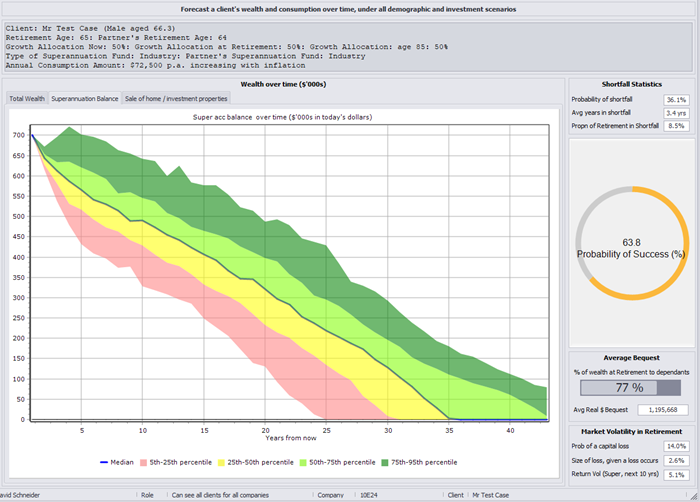
In each simulation year allowance is made for the impact of taxation, the Australian age pension and the potential for a retiree to dynamically adjust their strategy as their personal funding level and health status varies over time. In addition, at the end of each simulation year consideration is given to the potential that a retiree could purchase a post-retirement product such as an annuity, or release equity from their personal home.Differing consumption, investment and product utilisation strategies are then explored and rated relative to the retiree’s preferences or goals. Each strategy is scored based on the manner in which the strategy:
* reduces the risk of the retiree becoming wholly reliant on the age pension,
* maximises the (utility adjusted) proportion of discretionary spending enjoyed
* limits the risk of short-term capital loss from investment returns, and
* reduces consumption volatility in retirement.
Our Methodology
10E24 has extensive experience developing online calculators and modelling tools that help retirees and advisers to make better financial decisions. We believe the most robust actuarial method to address this problem is through stochastic simulation, capturing the full range of possible investment and lifespan outcomes a retiree may face.Our models typically consider:
• At least 2,000 carefully calibrated stochastic investment scenarios (incorporating simulated inflation and market returns across all major asset classes and typical superannuation investments), and
• 1,000 demographic scenarios (e.g. simulated lifespan scenarios for each spouse in a couple) based on age, gender and health status.
This results in at least two million total scenarios (2,000 × 1,000). For each scenario, our retirement server projects all major household cashflows, spending, and balance sheets over time. The projections are used to assess the range of outcomes from any annuitisation and consumption plan.
Built-in optimisers then re-run the stochastic projections to test alternative client decisions and determine how to best meet their objectives — such as minimising the risk of running out of money and becoming fully reliant on the Age Pension.
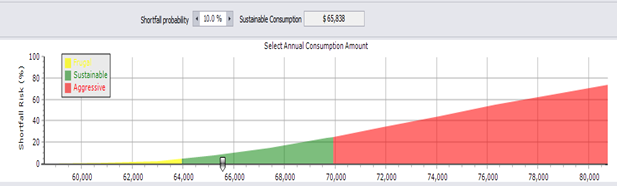
The above chart shows the trade off between spending (on the bottom axis) and the probability that the client runs out of money, experiencing a shortfall in retirement (vertical axis). The chart is shaded red, displaying spending zones where the client's spending plan has a material risk of shortfall, the green zone is what we refer to as "Sustainable Consumption" where risk of shortfall is limited to a low threshold (typically less than 25%). The Yellow zone (shown on the left of the chart) represents consumption plans where the risk of shortfall is extremely low - these plans could be considered as excessively frugal
Presentation to the Actuaries Institute Financial Services Forum
David Schneider presented on the approach used by 10E24 at the Australian Actuaries Institute's 2016 FSF. The presentation describes the approach used by traditional financial planning software in which a best estimate assessment is made regarding investment returns and a couple's lifespan. The presentation explains the concerns with this approach and how 10E24's methodology allows for tail longevity and sequencing risksActuaries Institute
Technical Paper: Good Practice Principles for Retirement ModellingThe approach we use is consistent with this Technical Paper by the Actuaries Institute, which isn't surprising as the Technical Paper builds on prior work by Jim Hennington and Glen Landon (presented by Jim Hennington and Glenn Langton at the Actuaries Summit in 2016 and can be downloaded from the Institute’s website). The paper also references 10E24's approach and includes charts from our RAPS software (page 43 of the report).